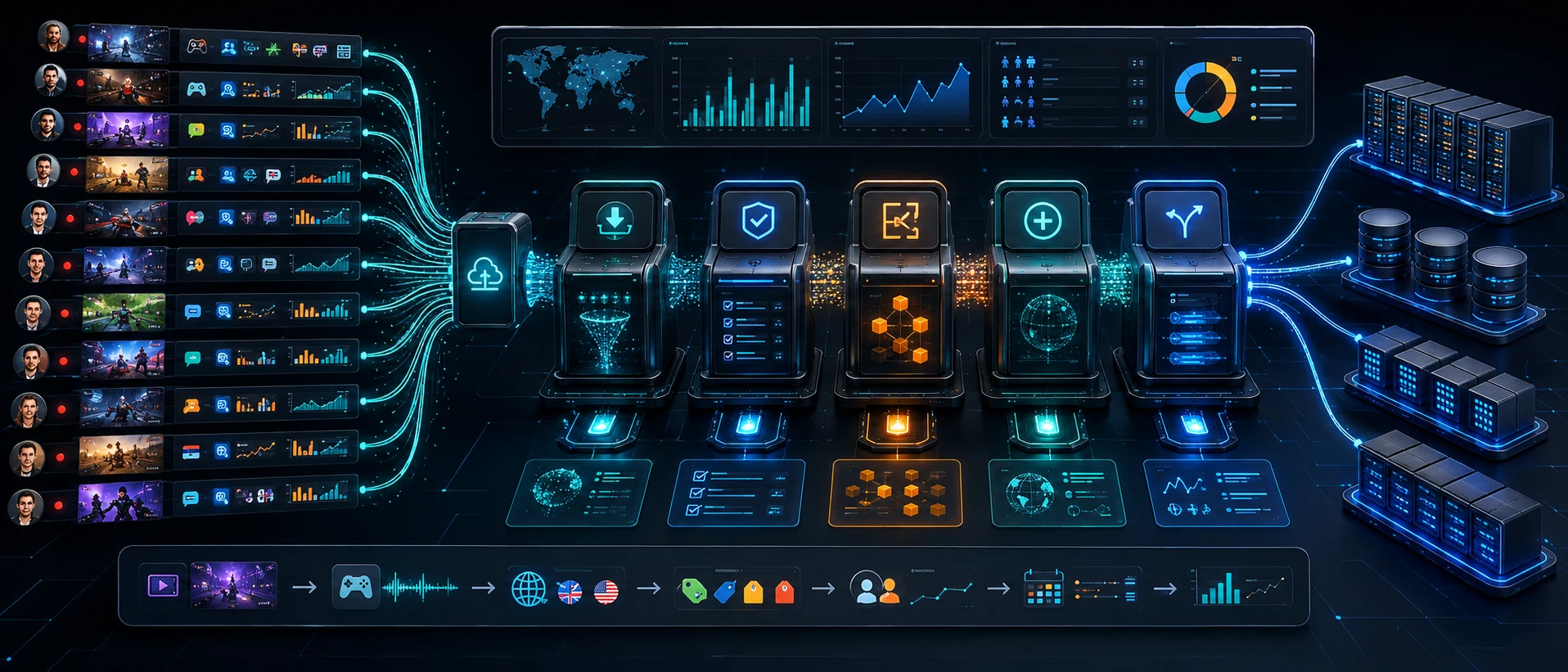
Scheduling should reflect source behavior
Not every resource should be collected at the same frequency. Live streams may need regular updates while a channel is active, but a stable public profile may require only occasional refreshes. Scheduled events can be checked near their expected start time. Recently ended streams may need a final update to capture closing values. A source-aware scheduler reduces unnecessary requests by changing its behavior according to known state. It should also include randomization so many jobs do not begin at exactly the same second.
Requests should enter a queue rather than being executed directly from every scheduling process. A queue provides visibility and control. Workers can process jobs at a rate appropriate to each platform and credential. Priorities can distinguish active streams from background profile refreshes. Duplicate jobs can be collapsed before they consume requests. If a source becomes unavailable or returns a rate-limit response, workers can pause without losing the pending work. The queue therefore separates the desire to collect from the ability to collect safely.
Validation begins when a response arrives. The system should confirm required identifiers, expected types, supported enumerations, and valid timestamps. Invalid records should not silently enter production storage. They can be routed to a quarantine area with the source response, validation errors, and retrieval context. Operators can then determine whether the source changed, the schema is incomplete, or the response represents an unusual but legitimate case. Quarantine prevents one unexpected payload from damaging downstream processing.
Normalization converts source-specific fields into a consistent internal representation. Platforms may use different names for language, category, schedule, tags, viewer counts, and channel identifiers. The normalized record can provide common fields while preserving the original source values. This is especially important when categories do not map perfectly. A normalized category should not pretend that two platform taxonomies are identical. The system can store the common grouping, source category, mapping version, and confidence or rule used.
Deduplication should rely on stable identifiers and source context rather than text similarity alone. Two channels may use the same title. One channel may repeat a title across many sessions. A stream identifier may change when a broadcast restarts. The collector should define what represents a channel, session, observation, and update. Idempotent processing allows the same source response to be handled more than once without creating duplicate records. This matters because queues and retries can legitimately deliver repeated work.
Finally, the pipeline should publish records only after validation and normalization succeed. Downstream analytics, search, and directory systems can subscribe to the resulting events or read prepared storage. Each record should carry retrieval time, source, schema version, and processing status. The pipeline becomes trustworthy when every transformation can be explained. Operators can trace a displayed value back to the source response, identify the rules applied, and correct the process if those rules later prove incomplete.