Assume every external dependency will fail
Platform APIs may become unavailable, return partial responses, enforce new limits, or experience regional problems. Network routes may fail. Credentials may expire. Internal storage may slow down. A collector should treat these events as expected operational conditions rather than extraordinary surprises. Resilience begins by defining what each failure means. Some errors should be retried quickly, some after a longer delay, some only after manual review, and some should stop processing because the request itself is invalid.
Backoff protects both the collector and the source. Repeating a failed request immediately can increase load during an outage and consume rate limits without producing useful data. Exponential backoff with randomization spreads retries over time. Maximum attempt counts prevent individual jobs from remaining active forever. A dead-letter queue can preserve repeatedly failing work for investigation. Operators should be able to see why jobs were moved there and whether the problem affects one record, one credential, one region, or the entire source.
Circuit breakers stop a failing dependency from consuming the whole system. When error rates cross a defined threshold, the collector can pause new requests to that source and periodically test whether service has recovered. Other sources and internal processing can continue. This isolation prevents one platform outage from filling queues, exhausting workers, or causing storage pressure across the entire network. Recovery should be gradual so a returning source is not immediately overwhelmed by the backlog accumulated during the outage.
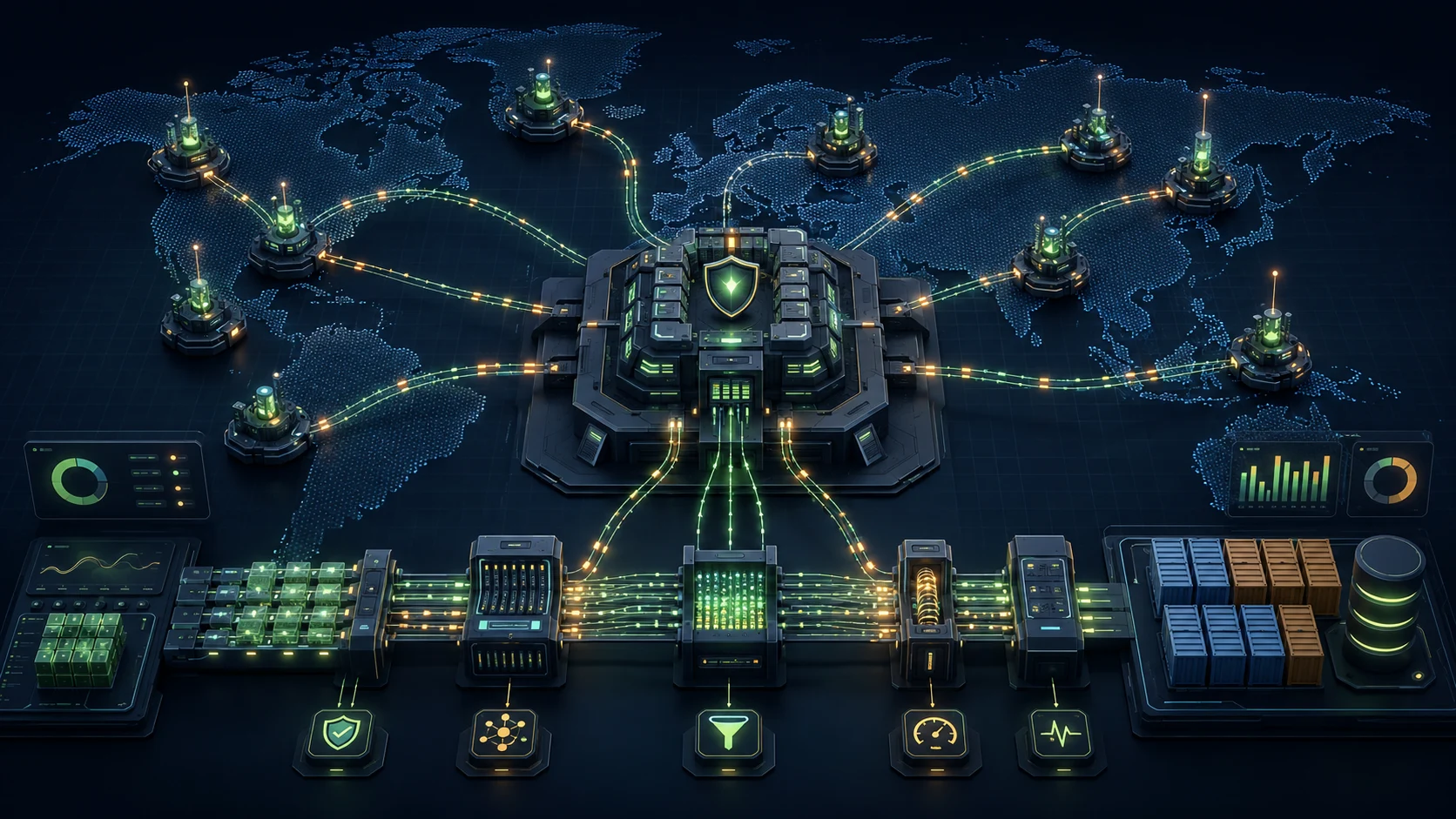
Regional distribution can improve reliability, but it adds complexity. Nodes may observe different network conditions or source restrictions. Clocks must be synchronized. Jobs must not be processed twice unintentionally. Credentials may have regional limitations. Data residency requirements may affect where records can be stored or processed. A distributed design should exist because it solves a documented need, not simply because multiple regions appear more advanced. Centralized coordination and clear ownership remain necessary even when workers are geographically separated.
Storage resilience requires its own plan. Raw responses, normalized records, queue state, and operational logs may use different systems with different recovery requirements. The collector should know which information can be reconstructed from the source and which cannot. Backups should be tested rather than merely configured. Schema changes should be reversible where possible. A processing deployment should not make old records unreadable without a migration strategy. Data integrity matters more than uninterrupted collection because silently corrupted records create misleading downstream results.
Communication completes the resilience model. Downstream users should be able to see when data is delayed, incomplete, or temporarily unavailable. A freshness timestamp is more honest than displaying an old value as though it were current. Incident notes should identify affected sources and periods without exposing sensitive infrastructure details. Resilience is therefore not only the ability to keep software running. It is the ability to preserve accurate expectations while systems recover from conditions that cannot be completely prevented.